


Many industrial facilities overlook wheel quality when arranging moving equipment, yet faulty casters remain one of the top hidden causes of frequent downtime, unexpected maintenance costs, and safety hazards on production floors. Most buyers only focus on unit price and appearance, ignoring load capacity matching, wear resistance, ground adaptability, and silent operation performance. These neglected details directly lead to frequent wheel cracking, excessive noise, rolling resistance increase, and shortened overall service life of handling machinery. Choosing reliable heavy duty polyurethane industrial casters can fundamentally solve these pain points and stabilize long-term operation of all mobile industrial equipment.
Workshops, warehouses, logistics platforms, and mechanical supporting equipment all face different ground conditions, load fluctuations, and continuous working hours. Ordinary rubber and nylon casters deform rapidly under heavy pressure, leave marks on epoxy floors, and produce harsh friction noise during high-frequency movement. They also slip easily on smooth wet surfaces and cannot bear long-time heavy load rolling. Professional industrial grade PU casters designed for harsh working environments avoid these common defects, achieving stable load bearing, floor protection, and low-noise operation at the same time.
Long-term heavy-load operation accelerates internal structural fatigue of casters. Low-quality products use inferior bonding technology between wheel core and wheel surface, which causes delamination, falling off, and wheel body separation after short use. Once casters break during material transportation, they may cause goods dumping, equipment collision, and even on-site safety accidents. Strict production standards and integrated molding technology greatly improve the bonding firmness and shock resistance of caster products, avoiding sudden failure in continuous high-intensity work scenarios.
Many enterprises misunderstand that all polyurethane casters have identical performance. In fact, hardness formula, wear resistance ratio, pressure resistance parameter, and anti-aging ability vary greatly between different grades. Soft PU wheels wear fast; overly hard PU wheels damage the ground and increase pushing force. Unformulated raw materials also turn yellow, harden, and crack quickly under sunlight, oil corrosion, and low temperature. Professional customized formula PU casters from Qianyue Caster Manufacturer balance hardness, elasticity, oil resistance, weather resistance and pressure resistance perfectly for diversified industrial scenarios.
Improper caster configuration amplifies hidden equipment problems. Unmatched load rating leads to excessive wheel deformation, increases motor burden of electric handling vehicles, raises energy consumption, and shortens service life of vehicle bodies. Unreasonable bracket structure causes unstable steering, deviation during moving, and difficult directional control. Reasonable matching of wheel diameter, bracket thickness, bearing type and load grade can greatly reduce labor intensity of manual handling, improve logistics efficiency, and cut comprehensive maintenance expenses throughout the equipment cycle.
Core Performance Comparison of Common Industrial Caster Materials
| Material Type | Load Bearing Performance | Floor Protection | Wear Resistance | Noise Level | Oil & Chemical Resistance | Applicable Scenarios |
|---|---|---|---|---|---|---|
| Ordinary Rubber | Medium load, easy deformation | Poor, easy to leave stains | Low, rapid abrasion | Medium noise | Weak corrosion resistance | Light load indoor temporary handling |
| Nylon Plastic | High hardness, brittle fracture risk | Scratches epoxy floors easily | Average wear resistance | High harsh noise | Poor oil resistance | Dry flat ground light machinery |
| Premium PU Polyurethane | Ultra-high heavy load, no permanent deformation | No scratches, no floor marks | Excellent long service life | Ultra-silent low friction | Strong oil & corrosion resistance | Warehouses, workshops, heavy equipment, frequent continuous handling |
Deep hidden problems that most users ignore include temperature adaptability and bearing durability. In low-temperature winter environments, ordinary PU wheels become brittle and crack; high-temperature working areas accelerate aging and melting. Ordinary plain bearings lock up easily after dust intrusion, increasing rolling resistance sharply. High-quality heavy-duty casters adopt sealed precision ball bearings, resist dust accumulation, adapt to wide temperature ranges, and remain flexible rolling whether in cold storage, high-temperature workshops or dusty production areas.
Ground adaptability directly determines actual service life. Cement rough ground, epoxy smooth ground, anti-slip matte ground, and outdoor muddy ground all require different wheel surface designs. Smooth PU wheels slip on wet ground; overly rough wheels increase pushing resistance greatly. Optimized tread pattern design enhances grip without damaging the ground, adapts to complex indoor and outdoor working conditions, and maintains stable rolling state under variable load and complex road conditions.
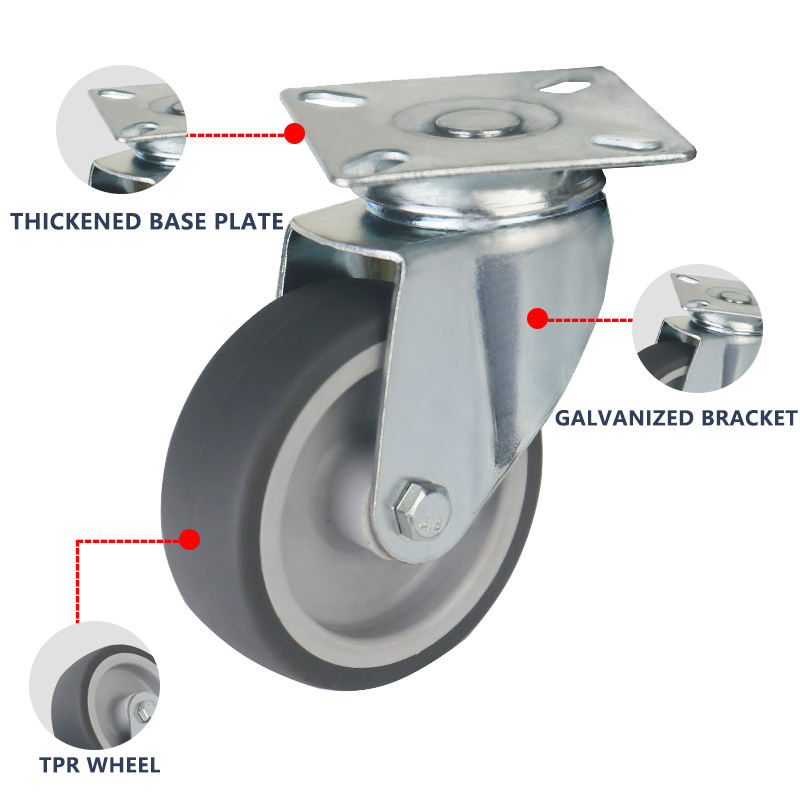
Safety and compliance are essential hidden requirements for industrial production. Unqualified casters have insufficient braking performance, leading to sliding displacement of equipment on slopes and inclined ground. Poor welding brackets break under impact force, bringing major safety risks. Standard heavy-duty casters are equipped with reliable double braking structures, thickened forged steel brackets, and anti-loosening nuts, meeting industrial safety specifications and reducing accident probability in continuous logistics operation.
Long-term cost calculation proves that low-price cheap casters bring higher total expenditure. Frequent replacement, shutdown maintenance, equipment damage, and accidental losses far exceed the price difference of high-quality products. Durable heavy-duty PU casters reduce replacement frequency, lower daily maintenance workload, stabilize production rhythm, and create obvious long-term economic benefits for factory operation. Reasonable caster selection is not an extra cost, but a necessary investment to improve overall industrial logistics efficiency and operation safety.